|
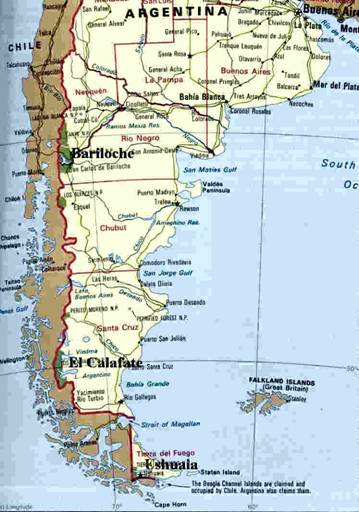
Bariloche
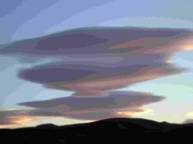
Sunrise on the way to Bariloche
|
|
 We passed mile after hundreds of miles of the flattest
land you can imagine, the highest hill being a mound of manure. By dawn, nothing had changed and it wasn't
until we reached quite close to Bariloche, full name San Carlos de Bariloche,
that we finally saw hills and then mountains. We passed mile after hundreds of miles of the flattest
land you can imagine, the highest hill being a mound of manure. By dawn, nothing had changed and it wasn't
until we reached quite close to Bariloche, full name San Carlos de Bariloche,
that we finally saw hills and then mountains.
|
|
Lake Nahuel Huapi
|
|
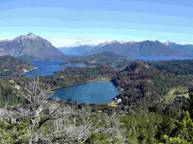 Bariloche,
with its hilly-to-mountainous terrain, lies in the lake district between
1800, Lake Nahuel Huapi's level, and 2300 feet, and
stretches many klicks along the lake, which touches
on Chile, I think, or quite close to it anyway. It's quite a lot colder and windier than Buenos Aires so though our room lacked a fridge we found that
putting our grapes, cheese, bread, mustard, tomato, pate, beers and milk on
the ledge outside the window kept them as cool as any fridge would have done. Bariloche,
with its hilly-to-mountainous terrain, lies in the lake district between
1800, Lake Nahuel Huapi's level, and 2300 feet, and
stretches many klicks along the lake, which touches
on Chile, I think, or quite close to it anyway. It's quite a lot colder and windier than Buenos Aires so though our room lacked a fridge we found that
putting our grapes, cheese, bread, mustard, tomato, pate, beers and milk on
the ledge outside the window kept them as cool as any fridge would have done.
|
|
Town Square
|
|
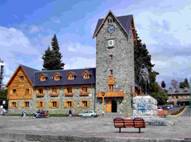 The town itself
is highly reminiscent of Bavarian or Swiss architecture and was in fact home
to many German and Swiss settlers.
It's famous in Argentina for its chocolates and a lot of its income comes, of course,
from tourism. Like all three stops on
our tour, the main drag was All Tourist, All The Time - and damned quaint in
this case. The town itself
is highly reminiscent of Bavarian or Swiss architecture and was in fact home
to many German and Swiss settlers.
It's famous in Argentina for its chocolates and a lot of its income comes, of course,
from tourism. Like all three stops on
our tour, the main drag was All Tourist, All The Time - and damned quaint in
this case.
|
|
Our
Hotel.)
|
|
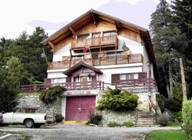 Our hotel's owner, Karl of German descent, is like all
Argentines, educated and aware. Unlike
many we've met, he was delighted with the currency crisis of 2001 because Argentina was suddenly a cheap destination for other Latin
Americans. His opinion about Peron was
that he was an old man who rode motorcycles with young girls on the back and
that Evita was a whore. (According to
a mostly praiseful book I read about Evita, the bit about Peron was true in
his second term; Evita's loose reputation was
probably untrue.) Karl and his wife
were getting too old to continue operating the hotel much longer and were
looking to sell it. As he put it in his memorable phrase, they were
'scratching at heaven.' Our hotel's owner, Karl of German descent, is like all
Argentines, educated and aware. Unlike
many we've met, he was delighted with the currency crisis of 2001 because Argentina was suddenly a cheap destination for other Latin
Americans. His opinion about Peron was
that he was an old man who rode motorcycles with young girls on the back and
that Evita was a whore. (According to
a mostly praiseful book I read about Evita, the bit about Peron was true in
his second term; Evita's loose reputation was
probably untrue.) Karl and his wife
were getting too old to continue operating the hotel much longer and were
looking to sell it. As he put it in his memorable phrase, they were
'scratching at heaven.'
|
|
Holly
on the Heights
|
|
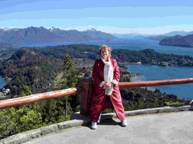 Aside from trekking and mountain
climbing (much higher than the town's roughly maximum 2300 feet), there were three
main attractions in Bariloche: a chairlift to the mountains called Campanario with its panoramic views of the lakes, a boat
trip to a couple of islands in the main lake, and an area described as
caverns, touting a lake in one of the caverns. Aside from trekking and mountain
climbing (much higher than the town's roughly maximum 2300 feet), there were three
main attractions in Bariloche: a chairlift to the mountains called Campanario with its panoramic views of the lakes, a boat
trip to a couple of islands in the main lake, and an area described as
caverns, touting a lake in one of the caverns.
|
|
Bindle
Catches Dinner
|
|
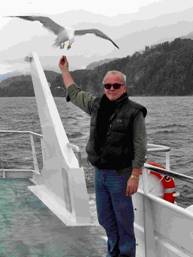 The boat trip was a trifle rainy,
nothing serious, and had the bonus of seagulls, those aero-marine
opportunists and omnivores, who would snatch bits of bread and cake from your
hands. The islands’ forests were well
cared for, with quite a number of different species from other countries and
continents, even giant sequoia from California. This place has a lot of wood to spare, it
seems, and the tourist walkways to climb to the top of the island were made
of two quite lovely species of wood.
The main island, Victoria, had a chair
lift, but it had been under repair for at least a year, we were told, yet
yielded an interesting photo op. The boat trip was a trifle rainy,
nothing serious, and had the bonus of seagulls, those aero-marine
opportunists and omnivores, who would snatch bits of bread and cake from your
hands. The islands’ forests were well
cared for, with quite a number of different species from other countries and
continents, even giant sequoia from California. This place has a lot of wood to spare, it
seems, and the tourist walkways to climb to the top of the island were made
of two quite lovely species of wood.
The main island, Victoria, had a chair
lift, but it had been under repair for at least a year, we were told, yet
yielded an interesting photo op.
|
|
The
Face of Patagonia
|
|
 The mountaintop
panorama, with a working chair lift, was pleasant enough - not much to say
about it that the pix won't say better -- but the caverns were way
over-billed. At best, the caverns were
caves and that lake-in-the-cavern came at the end of a four-hour hike up the
hills that consisted mostly of talks by the guide that could have been given
in a couple of pages of handout instead.
The 'lake' was a small pool whose most interesting aspect might have
been the narrow crawlway that you had to negotiate to get to it. The mountaintop
panorama, with a working chair lift, was pleasant enough - not much to say
about it that the pix won't say better -- but the caverns were way
over-billed. At best, the caverns were
caves and that lake-in-the-cavern came at the end of a four-hour hike up the
hills that consisted mostly of talks by the guide that could have been given
in a couple of pages of handout instead.
The 'lake' was a small pool whose most interesting aspect might have
been the narrow crawlway that you had to negotiate to get to it.
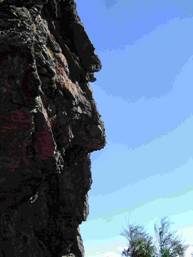
But our guide did point out a narrow
vantage point from where one could see the profiled 'Face of Patagonia' on
the edge of a cliff. (The name Patagonia derives from a Spanish word
for 'Big Foot.' The first European
explorers here were amazed to find that the locals were quite tall, up to a
couple of meters - nearly seven feet - with big feet to match.)
|
|
|
|
El Calafate
Our Digs
|
|
 After three days in
Bariloche, we flew to El Calafate.
Calafate town itself is rather dismal as towns go: there's the one
street that's All Tourist, All The Time, and the rest seems to be mostly
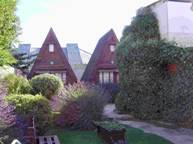
manufactured housing at best, like trailers but probably without axels. Our own digs were super quaint, a
steep-roofed bungalow with bunk beds on the bottom floor and the 'matrimonial'
bed in the loft. A ‘greenhouse’ that
belonged to the hotel had a little two-burner range that they let the tenants
use, and so we did. After three days in
Bariloche, we flew to El Calafate.
Calafate town itself is rather dismal as towns go: there's the one
street that's All Tourist, All The Time, and the rest seems to be mostly
manufactured housing at best, like trailers but probably without axels. Our own digs were super quaint, a
steep-roofed bungalow with bunk beds on the bottom floor and the 'matrimonial'
bed in the loft. A ‘greenhouse’ that
belonged to the hotel had a little two-burner range that they let the tenants
use, and so we did.
El Calafate (it’s named after a plant) is the most
visited glacier park in Argentina and home to the glacier
named after Francisco "Perito" Moreno. Moreno seems to have been the
Lewis and Clark of Argentina, exploring all through Patagonia where on one occasion the
Patagonian Indians captured him - I think it was over a cattle dispute that
he had nothing to do with - and condemned him to death which he escaped by, er, escaping the day before he was to be done in.
|
|
Steamed
Perito
|
|
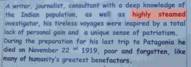 A
tourist plaque we saw down here says Moreno died penniless and unknown, somewhat at variance
with the article from Wikipedia in the appendix
though perhaps Wiki refers to his renown
today. (The plaque also said that he
was 'highly steamed,' which seems unlikely or at least unnecessarily
harsh.) We went to a museum in
Bariloche which had several pictures and caricatures of him, including one
where he leads a tiny visiting Teddy Roosevelt around. Certainly, Perito Moreno is well known
today with streets, towns, and glaciers named after him. A
tourist plaque we saw down here says Moreno died penniless and unknown, somewhat at variance
with the article from Wikipedia in the appendix
though perhaps Wiki refers to his renown
today. (The plaque also said that he
was 'highly steamed,' which seems unlikely or at least unnecessarily
harsh.) We went to a museum in
Bariloche which had several pictures and caricatures of him, including one
where he leads a tiny visiting Teddy Roosevelt around. Certainly, Perito Moreno is well known
today with streets, towns, and glaciers named after him.
|
|
Bee
on Flower
|
|
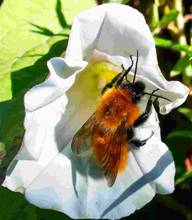 The gardens of El Calafate
were remarkable, as you can see in the flora album. One imagines that the otherwise bleakness
of the terrain drives the inhabitants to grow their profusions of
colors. Technically speaking, El
Calafate is in a desert, judged by the rainfall numbers, but it has three distinct
terrains that depend on altitude. The
lowest is a scrub desert, the next one upward is a mono-species forest, and
the last is glacial. The gardens of El Calafate
were remarkable, as you can see in the flora album. One imagines that the otherwise bleakness
of the terrain drives the inhabitants to grow their profusions of
colors. Technically speaking, El
Calafate is in a desert, judged by the rainfall numbers, but it has three distinct
terrains that depend on altitude. The
lowest is a scrub desert, the next one upward is a mono-species forest, and
the last is glacial.
(As we departed El Calafate and its
rolling scrub desert, I attempted to take a picture of the boring landscape
surrounding the isolated airport and was stopped by a guard who informed me
that photos were forbidden. Good
heavens! To protect it from the
invading Chilean hordes? Not to
mention that Chilean spies could just bring mobile phones that
take pictures. A silly bit of
vestigial policy.)
|
|
Holly’s
Glacial Picture
|
|
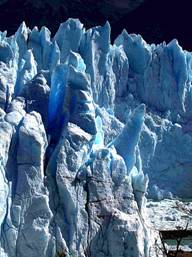 There were viewing 'balconies' at various levels across
from the glacial face, and a plaque at the descent to the lowest one warned -
yes, warned -- that it was a 400-meter downward trip and, hence, 400 meters
back up again. I declined to make that
trip but spry Holly did it and so the best pictures of the glaciers are
hers. The bluer the ice, we were told,
the older it is. There were viewing 'balconies' at various levels across
from the glacial face, and a plaque at the descent to the lowest one warned -
yes, warned -- that it was a 400-meter downward trip and, hence, 400 meters
back up again. I declined to make that
trip but spry Holly did it and so the best pictures of the glaciers are
hers. The bluer the ice, we were told,
the older it is.
Everyone who takes up photography as
a serious hobby has his share of miracle pictures. I saw one in a book about the Serengeti, by
a serious photographer, not just amateurs like us, of a cheetah and a gazelle
back to back. In this case, back to
back was as the gazelle, in a desperate attempt (and futile, according to the
text) to escape capture had performed an aerobatic barrel roll, legs pointing
to the sky, over the back of the pursuing cheetah. Each of us got a miracle picture on this
trip and mine occurred in Calafate when I was snapping a flower and just as I
did a bee landed on it. Holly's miracle
picture comes in Ushuaia.
|
|
Holly’s
Miracle Picture
|
|
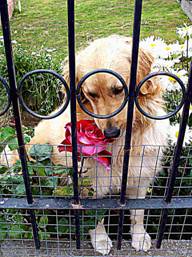 You can never get a dog to sit still long enough to take
a picture like this, but according to Holly, he seems to have posed for it. You can never get a dog to sit still long enough to take
a picture like this, but according to Holly, he seems to have posed for it.
|
|
|
|
Tierra del Fuego
From
the Window
|
|
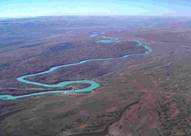 It's
been a long time since I've been on a plane that bounced when it landed,
thanks to almost everything in flying a plane now being computerized, but the
touchdown in Ushuaia town, surrounded by mountains and the sea, was a mild
three-bouncer. (One great insight
struck me on this trip: one of the charms of Buenos Aires is that it’s on a flood plain and just about flat,
an easy walking town, almost no hills to
climb.) Otherwise it was a great
flight, much more legroom than one is used to; perhaps the luxury of the
busses makes passengers here less herd-like.
As we wait for our luggage at the carousel, an ad suggests we see
"Adventure of the Beagle," the Show and Musical. We pass. It's
been a long time since I've been on a plane that bounced when it landed,
thanks to almost everything in flying a plane now being computerized, but the
touchdown in Ushuaia town, surrounded by mountains and the sea, was a mild
three-bouncer. (One great insight
struck me on this trip: one of the charms of Buenos Aires is that it’s on a flood plain and just about flat,
an easy walking town, almost no hills to
climb.) Otherwise it was a great
flight, much more legroom than one is used to; perhaps the luxury of the
busses makes passengers here less herd-like.
As we wait for our luggage at the carousel, an ad suggests we see
"Adventure of the Beagle," the Show and Musical. We pass.
|
|
Bar
in Ushuaia
|
|
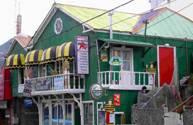 Ushuaia
town was much more interesting and charming than either Bariloche or
Calafate. Though it had its own street
with Ad Hoc Charm for the tourists - and woe to the tourist business that
opened a mere block from it - it seems to have been a real town for longer
than the other two. (Bariloche is
certainly as old but did not mushroom until ski tourism, I think.) Houses were gaily painted, like La Boca,
but seemingly without the intent to draw tourists. Unfortunately – and deceptively – we didn’t
have the time to get to the ‘suburbs’ where the really nice houses are and so
most of the pictures are of dilapidated houses. Ushuaia
town was much more interesting and charming than either Bariloche or
Calafate. Though it had its own street
with Ad Hoc Charm for the tourists - and woe to the tourist business that
opened a mere block from it - it seems to have been a real town for longer
than the other two. (Bariloche is
certainly as old but did not mushroom until ski tourism, I think.) Houses were gaily painted, like La Boca,
but seemingly without the intent to draw tourists. Unfortunately – and deceptively – we didn’t
have the time to get to the ‘suburbs’ where the really nice houses are and so
most of the pictures are of dilapidated houses.
|
|
Marcial
Forest
|
|
 Perhaps, as I suspect of Calafate's
gardens, the bleakness of the terrain had a part to play in the colorful
houses. And maybe this contributes to
the town’s prolific use of its wall spaces with art, which also no doubt
discourages the graffiti blight that so many towns the world over suffer
from. As in Calafate, gardens are
popular here. And here’s where Holly’s
magical picture came when she snapped a wonderfully framed dog just as he
seemed to be sniffing a flower. Perhaps, as I suspect of Calafate's
gardens, the bleakness of the terrain had a part to play in the colorful
houses. And maybe this contributes to
the town’s prolific use of its wall spaces with art, which also no doubt
discourages the graffiti blight that so many towns the world over suffer
from. As in Calafate, gardens are
popular here. And here’s where Holly’s
magical picture came when she snapped a wonderfully framed dog just as he
seemed to be sniffing a flower.
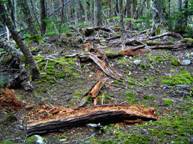
One of the most memorable
experiences was after (yet another) chairlift. We elected to walk down through a magical, Tolkein-esque forest, like Mirkwood. It was the only time I actually ran out of
space on my camera’s memory stick. If
there are only a few pix in the album of this forest, it’s because many of
them would probably look the same to those for whom they’re not memory
stimulants.
|
|
Pizzas
from God
|
|
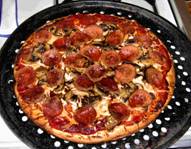 I’m on a Mission from God to sample pizza
all over the world. I even have a
Pepperoni Parable for Life. I was in Germany once with a group of
friends at an Italian restaurant and, on my divine quest, I ordered my
pepperoni pizza. Everyone’s pizza
arrived but mine yet there was one left over in the middle of the table with
long, green peppers on it. In Germany, it turns out, pepperoni
means long green peppers and what we call pepperoni they call pepperonchini. I
ate it anyway and it became one of my principles of life: sometimes you don’t
get pepperoni, don’t get too upset about it. I’m on a Mission from God to sample pizza
all over the world. I even have a
Pepperoni Parable for Life. I was in Germany once with a group of
friends at an Italian restaurant and, on my divine quest, I ordered my
pepperoni pizza. Everyone’s pizza
arrived but mine yet there was one left over in the middle of the table with
long, green peppers on it. In Germany, it turns out, pepperoni
means long green peppers and what we call pepperoni they call pepperonchini. I
ate it anyway and it became one of my principles of life: sometimes you don’t
get pepperoni, don’t get too upset about it.
Surely I would have been remiss to skip The End of
the World Pizza. Who would have
thought that you had to come to the end of the world in Argentina to get a decent Argentine
pizza, but that’s how it turned out.
(And, no, that’s not a pizza from Ushuaia, that’s from home.)
|
|
Ushuaia
Prison
|
|
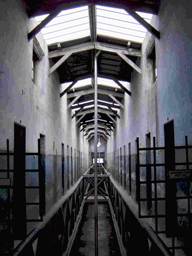 Back to the town: Ushuaia was populated first by
non-indigenous people in late 19th century but the native population goes
much further back. Despite its
latitude, about nine degrees, some 600+ miles, from the arctic circle, people
have lived down here for thousands of years.
Though there were missionaries and seal hunters by the last third of
the 1800s, the real boom came with the prison system, first begun in the last
decade of the century. (It was first
located on Staten Island, perhaps no surprise to New Yorkers, but was
relocated in 1903 to the larger island on which Ushuaia is situated.) Back to the town: Ushuaia was populated first by
non-indigenous people in late 19th century but the native population goes
much further back. Despite its
latitude, about nine degrees, some 600+ miles, from the arctic circle, people
have lived down here for thousands of years.
Though there were missionaries and seal hunters by the last third of
the 1800s, the real boom came with the prison system, first begun in the last
decade of the century. (It was first
located on Staten Island, perhaps no surprise to New Yorkers, but was
relocated in 1903 to the larger island on which Ushuaia is situated.)
It was virtually escape-proof. Not because they were penned in or heavily
guarded but because there was virtually no place to go: the next nearest
Europeans were hundreds of miles away, the few ships in port *were* heavily
guarded against stowaways, and the climate was unforgiving. (It snowed slightly while we were there,
just after the end of autumn down here.)
In fact, the prisoners were lightly guarded despite being on work duty
away from the prison much of the time.
|
|
Ghosts
of Ushuaia Prison
|
|
 In its day, the jail was so
boring that working out in the cold, felling trees, was considered a
privilege and always had more than enough volunteers. So far as we were told, perhaps only one
prisoner managed to escape in the nearly half-century of its existence - it
closed in 1947 -- the rest were found frozen or dead by exposure or never
heard from again. Over the years, it
was home to criminals, politicians, and madmen - and I suppose some of them
were all three. It was, by the way,
exclusively a male affair; there were no female prisoners, we were told. Although it was intended to hold only one
prisoner per cell, the more usual total came to about twice that number. In its day, the jail was so
boring that working out in the cold, felling trees, was considered a
privilege and always had more than enough volunteers. So far as we were told, perhaps only one
prisoner managed to escape in the nearly half-century of its existence - it
closed in 1947 -- the rest were found frozen or dead by exposure or never
heard from again. Over the years, it
was home to criminals, politicians, and madmen - and I suppose some of them
were all three. It was, by the way,
exclusively a male affair; there were no female prisoners, we were told. Although it was intended to hold only one
prisoner per cell, the more usual total came to about twice that number.
The prison was a self-sufficient
community with workshops, a hospital, printing press, photographic works,
shoe makers - in short, it had all the things they needed because otherwise
those things were very far away.
Although it's certain that there would eventually have been a town
there, in the event it was the prison that built the town. Since then, in order to strengthen Argentina's hand vs
Chile's, tax and other incentives
were granted to foreign companies, especially the electronics sector, to open
factories there. It was the civilian
counterpart of a 'boots on the ground' strategy on the part of the
Argentines. As it is, you can't get
from Ushuaia to the rest of Argentina via the shortest straight
line without passing through Chile. The population skyrocketed as a result from
a few thousands to now about 70 thousand, all in a few decades.
|
|
Holly
Ministers to a Prisoner
|
|
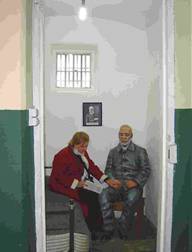 The
prison today is a museum and one of the more entertaining ones I've been in .
. . er, museums that is, not prisons. A few wings of the prison - there were five
two-story wings - had their cells filled with the usual bric-a-brac of
museums everywhere, while others had latter-day wall paintings and many had
manikins of ordinary and famous tenants.
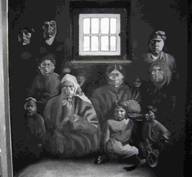
Some of the paintings are hauntingly evocative. (Holly visited parts I didn't, like the
glacier, and so some of the pictures are hers. Not this one, though.) The
prison today is a museum and one of the more entertaining ones I've been in .
. . er, museums that is, not prisons. A few wings of the prison - there were five
two-story wings - had their cells filled with the usual bric-a-brac of
museums everywhere, while others had latter-day wall paintings and many had
manikins of ordinary and famous tenants.
Some of the paintings are hauntingly evocative. (Holly visited parts I didn't, like the
glacier, and so some of the pictures are hers. Not this one, though.)
|
|
Train
at the End of the World
|
|
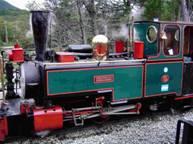 You don't go to Ushuaia without taking the Train at the
End of the World. (I was hoping to get
a t-shirt to tweak the Rapturists that said 'I
Survived the End of the World' but to my surprise there were none to be
had. Entrepreneurs, take note: there's
money to be made there.) It's one of
the narrowest-gauge railways in the world and now takes tourists through
'tree cemeteries.' It takes a long
time to grow a tree down there and despite five to ten decades having passed,
the places where the trees were felled still look like bone yards. You don't go to Ushuaia without taking the Train at the
End of the World. (I was hoping to get
a t-shirt to tweak the Rapturists that said 'I
Survived the End of the World' but to my surprise there were none to be
had. Entrepreneurs, take note: there's
money to be made there.) It's one of
the narrowest-gauge railways in the world and now takes tourists through
'tree cemeteries.' It takes a long
time to grow a tree down there and despite five to ten decades having passed,
the places where the trees were felled still look like bone yards.
Holly and I missed the train that
took everyone else back to Ushuaia town, Holly having done a bit of, er, exploring and gotten her cuffs festooned with
tag-along seeds. Since we clearly had
return trip tickets, we got a whole train to ourselves. Some people are rich enough to have their
own railway cars but it was mostly only presidents who had a whole train to
themselves!
|
|
Seal
(or Sea Lion) Guarding the Birds
|
|
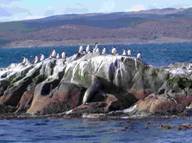 On
our next day in Ushuaia, we bought tickets on a boat that took tourists to
see the penguins but, alas, the sea was too stormy to let our catamaran out
of the harbor and that was that. We
did get a boat the next morning to see the fur seals, sea lions, and
cormorants who, from a distance, look just like
penguins anyway. (Other than that, the
only penguins we saw were the ubiquitous species of Street Penguins.) You can tell the seals from the sea lions,
by the way, because only the sea lions have external ear flaps. You’ll need sharp eyes for this one. (This is another place where I just about
ran out of memory stick but that’s because you never knew just which shots might
have gold when you look at them later, so we both overshot like crazy.) On
our next day in Ushuaia, we bought tickets on a boat that took tourists to
see the penguins but, alas, the sea was too stormy to let our catamaran out
of the harbor and that was that. We
did get a boat the next morning to see the fur seals, sea lions, and
cormorants who, from a distance, look just like
penguins anyway. (Other than that, the
only penguins we saw were the ubiquitous species of Street Penguins.) You can tell the seals from the sea lions,
by the way, because only the sea lions have external ear flaps. You’ll need sharp eyes for this one. (This is another place where I just about
ran out of memory stick but that’s because you never knew just which shots might
have gold when you look at them later, so we both overshot like crazy.)
|
|
Lighthouse
at the End of the World
|
|
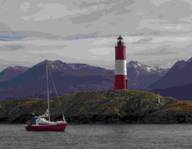 And,
of course, there’s the stock shot of the Lighthouse at the End of the World,
probably the most photographed lighthouse on the planet. And we got our passports ‘stamped’ with
proof that we’d been to the End of the World. And,
of course, there’s the stock shot of the Lighthouse at the End of the World,
probably the most photographed lighthouse on the planet. And we got our passports ‘stamped’ with
proof that we’d been to the End of the World.
|
|
Shadows
from the Balcony
|
|
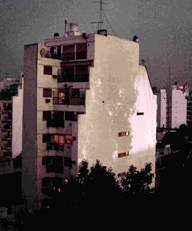 So
after ten whirlwind days that were kind of hard to sort into one place or
another until we began processing the photos, we headed back home. The plane was about an hour late departing
but that was hardly the worst of our surprises. We returned to find that repairmen had re-plastered
one of our walls on the balcony and the flat was painted with plaster
dust. It took hours to get it to
habitable condition but all in all it was one helluva
a trip. So
after ten whirlwind days that were kind of hard to sort into one place or
another until we began processing the photos, we headed back home. The plane was about an hour late departing
but that was hardly the worst of our surprises. We returned to find that repairmen had re-plastered
one of our walls on the balcony and the flat was painted with plaster
dust. It took hours to get it to
habitable condition but all in all it was one helluva
a trip.
|