solar power, electricity, photovoltaic
 Have questions?
Want a quote?
Have questions?
Want a quote?
Email: mickeytheo@usa.net
If you look on your electric bill and find out how many kilowatt
hours/month (kWh) of electricity you presently use from your electric company;
that would make it easy for us to customize a system for your home or business.
Email:
mickeytheo@usa.net
42775 Hwy. 79s, P.O. Box 553, Aguanga, CA 92536
Phone: 909 767 0606
We have 20 years experience and use free electricity from the sun exclusively
for all our home and business needs.
 Did
you know that Albert Einstein received
The Nobel Prize in Physics 1921 "for his services to Theoretical Physics,
and especially for his discovery of the law of the photoelectric
effect"
Did
you know that Albert Einstein received
The Nobel Prize in Physics 1921 "for his services to Theoretical Physics,
and especially for his discovery of the law of the photoelectric
effect"
You can now have free
electricity from the sun by using solar panels.
The systems are called photovoltaic (PV)systems.
The 3 mainTypes of PV (Photovoltaic) Systems are:
Small Stand-Alone DC System:
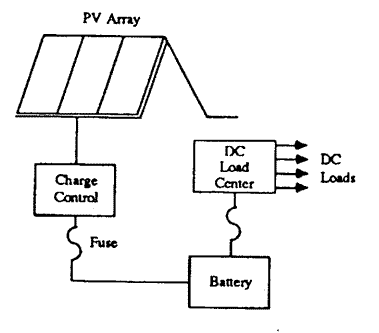
The Small Stand-Alone DC System is an excellent replacement
for propane or kerosene lights in a remote cabin, a recreational vehicle
or a boat. The size of the photovoltaic (PV) array and battery will depend
upon individual requirements. The actual sizing methods will be discussed
later. The PV array charges the battery during daylight hours and the battery
supplies power to the loads as needed. The charge controller terminates
the charging when the battery reaches full charge. The load center may
contain meters to monitor system operation and fuses to protect wiring
in the event of a malfunction or short circuit in the house.
PV - Generator Combination:

The PV - Generator Combination system may be an economical
alternative to a large standalone PV system, because the PV array does
not have to be sized large enough for worst-case weather conditions. A
gasoline, propane or diesel generator combined with a battery charger can
supply power when the PV array falls short. If the PV array is sized for
average conditions, then during extended overcast situations or periods
of in-creased load, the generator can be started. When batteries are low,
the generator will power the AC loads in the house as well as a battery
charger to help recharge the batteries, If the PV array is sized much smaller
than needed for normal use, the generator can power peak loads such as
doing laundry or pumping water and simultaneously run the battery charger
to charge the battery bank. In addition to allowing for a smaller PV array,
a back-up charging system may also allow use of a smaller battery bank.
Generator and battery bank size must be chosen carefully for reliable system
operation. See the system sizing section for more details on equipment
choice.
Utility Intertie:
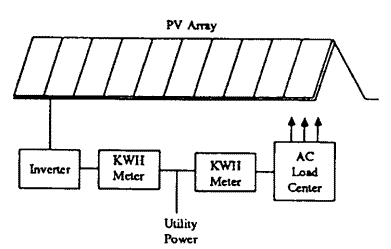
The Utility Intertie system is used in a grid connected
house. Instead of storing power in batteries, it is sold to the utility
company. The Utility Intertie System employs a special type of inverter,
which inverts DC power from the PV array into low distortion AC, acceptable
for purchase by the local utility power company. Batteries are not required
for storage. The power is delivered through a kilowatt-hour (kWh) meter
to the utility grid as it is produced by the PV modules. A second kWh meter
is used to measure the power consumed by the loads in the house. The user
of this system will notice no difference from any utility system, except
lower utility bills or possibly payments from the power company for the
excess electricity that is generated.