 Treating Boiler
Water Treating Boiler
Water
Steam generation has been an area of interest in
manufacturing since the industrial revolution. The method of steam
production has changed from the first pot and kettle type boiler to
the two basic types of boilers we have today. Fire tube boilers are
designed to permit improved water circulation and to increase the
heating surface area. Water tube boilers produce steam faster and at
higher pressures than fire tube boilers.
The process of making steam is familiar to us all. At
atmospheric pressure, water boils at 212F. In a closed vessel, the
pressure increases as steam is produced due to the large increase in
volume when water is changed from the liquid to a gas. As pressure
increases the boiling point of water increases.
A BTU ( British thermal Unit) is the amount of heat
required to raise one pound of water 1F. The heat value of fuels is
expressed as BTU's per pound gallon or cubic foot. Fuel oils average
150,000 BTU's whereas natural gas is measured at 1,000 BTU's cubic
foot.
When fuels is burned, the heat given off is transferred
through the boiler tubes to the boiler water. If there are any
deposits on the waterside or fireside heat transfer is impeded thus
resulting in additional heat to generate steam. Overheating boiler
tubes can result in failure.
Convection and radiation are the mechanisms by which
heat transfer takes place. Heat is absorbed from the hot combustion
gases as they pass through the fireside of the boiler. Each 40 to
50F rise in stack gas temperature results a one-percent decrease in
thermal efficiency.
Water circulation is obtained naturally when feedwater
is added to the boiler. The feedwater temperature is lower than the
boiler water temperature. Therefore the feedwater tends to fall as
the warmer water with steam bubbles rise. Baffles and other
separation devices are installed in the boiler to minimize potential
carryover. This makes the steam change direction, thus causing the
entrained boiler water to be left behind as the steam leaves the
boiler. As steam leaves the boiler it is saturated with water. For
most applications this is acceptable. However, if dryer steam is
needed more heat must be applied to the steam. This task is
accomplished by using a superheater. A superheater is a heat
exchanger that utilizes heat from the stack gas and passes it to the
saturated steam. This extra heat forces the moist steam to a fully
vaporized state.
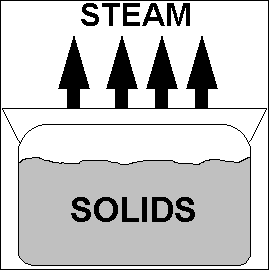 As steam is produced, any natural contaminants not
removed during feedwater pretreatment are left behind. The term for
this is cycling. Cycling is measured by the concentration of TDS
(Total dissolved solids) or conductivity over the concentration of
TDS or conductivity in the feedwater. If these suspended or
dissolved solids reach the point of saturation, deposition of the
heat transfer surfaces result. Boiler cycles are controlled by a
continuous blowdown situated near the top of the boiler where then
most concentrated boiler water exists. As steam is produced, any natural contaminants not
removed during feedwater pretreatment are left behind. The term for
this is cycling. Cycling is measured by the concentration of TDS
(Total dissolved solids) or conductivity over the concentration of
TDS or conductivity in the feedwater. If these suspended or
dissolved solids reach the point of saturation, deposition of the
heat transfer surfaces result. Boiler cycles are controlled by a
continuous blowdown situated near the top of the boiler where then
most concentrated boiler water exists.
Pre-treating the feedwater can control the solids in
the boiler. There are certain minerals in the incoming water that
cause severe deposition when they come in contact with heat transfer
surfaces.
Possible science experiment for
students
1. Weigh an empty 1000 ml beaker
2. Add 1000 ml water the weigh again.
3. Boil water until completely evaporated.
4. weigh the beaker again. subtract
the initial weight from the final weight.
5. Write conclusions
|








