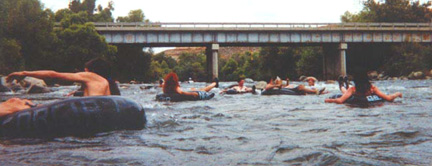
What's tubing?
| Several times each summer a group of people will camp along the Kern River and spend the weekend inner-tubing.
We now have 3 tubing runs; the main run is by the Ming Lake Campground east of Bakersfield. Also there are runs by Kernville north of Isabella Lake, and the advanced Dam Run just South of the Isabella Lake dam. Depending on the amount of water in the river, a run can take anywhere from 30 minutes to 2 hours. The rapids are not extreme, they are class 1, 2 and 3 (on a scale of 1 to 6), much of the run is spent slowly floating on calm smooth water. The Dam Run is mostly 3- to 3+. |
Tubing tips | rapids classifications
|
Here is the typical routine Folks begin arriving Friday night at the campground. If we camp at the Ming Lake Campground, we just tube from the campground. Otherwise, on Saturday morning we may leave our campsite and relocate; either to the Kernville Riverside Park, or to the Day Camp part of the Ming Lake Campground., There we set up a home base at the end of the tubing run. If we're camped south of the dam, we will probably tube from our campsite. If we are relocating, folks arriving Saturday morning may want to go directly to the day camp we are using that day. The first run of the day is usually around noon. As people continue to arrive, we fill up our tubes at a local gas Drinking alcohol in the Ming Lake Daycamp is permitted only with a permit. We usually don't have a permit (unless someone got up to Bakersfield by 4:30 Friday). The permit is not nessesary, for those camping at the Ming Lake Campground. Dogs are welcome, but must be kept on a leash while at the Ming Lake Campground. The county sheriff patrols the park and routinely gives tickets for violation of these 2 laws. The tickets are both very expensive (up to $100 or more). They also give tickets for too many cars at a site. At the end of the day we pack up and drive to our camping spot. There is a hot springs close by that we sometimes visit on Saturday nights. Sunday morning we pack every thing up and relocate at the Ming Lake Campground for more tubing. You don't need to bring a tube. |
| Most of our tubing run is slow moving calm water. There are 4 or 5 spots (depending on the water level) where we pass through rapids. These are class 1 and 2 rapids (see below) and one spot (about 25-30 yards long) is classified as class 3 (see photo on home page). |
|
What to do: |
Why to do it: |
|
Don't tube |
This my seem like a no-brainer, but some folks need to be told. When on your tube you are safe, but tubes are top heavy and can flip in the rapids. If you know how to swim it's no big deal. Weak swimmers should wear life jackets. Some people wear wet suits. |
|
Stay away from |
There are a lot of bushes and tree branches along both edges of the river. The river will pull you thru them and scratch you up, pull you off your tube, or suck and hold you underwater. It's not possible to stop yourself by grabbing a branch in a swiftly moving current. |
|
Hold on |
When splashing thru the rapids, your tube may flip over. If you keep both arms around each side of your tube when you flip you will be able to let go of one side while holding onto the other (depending on which way you flip). This will (1) keep you and your tube together and (2) keep you above water. |
|
Stay with the crowd |
If this is your first trip you don't want to go first, because you don't know where the hazards are. You don't want to be last, because you won't have help if you become separated from your tube. |
|
Keep you butt up |
There are a lot of big rocks just below the surface of the water, especially in the rapids, that can scratch or
bump your lower back. So lean back and keep your butt up. |
|
Paddle backwards, to get away from, or to go towards, something |
As you lay on your back in your tube you want to reach all the way back with both hands and pull the water forward propelling yourself backwards (just like in a row boat). This is the most powerful way to turn and move. |
|
When people are stopping to jump off a certain tree on the left bank, paddle over to the right bank to watch. (or keep going) |
(Unless you know you can make it around the dangerous tree branch sticking out of the left bank.) On the June trip someone got sucked under the branch by the strong current, got all scratched up, and thought that they might not make it. |
|
class 1: easy. class 2: novice. class 3: intermediate.
class 4: advanced. class 5: expert. class 6: extreme and exploratory. #### from: |